Abstract: E-commerce conversion rate optimization is no longer only about faster pages, cleaner forms, or better checkout design. In 2026, enterprise brands need to improve the full buying journey with proactive guidance, better product discovery, intent-aware recommendations, and AI sales agents that help shoppers buy with confidence.
This article covers the top e-commerce conversion rate optimization strategies:
- Optimize for buying confidence, not just clicks
- Use hesitation signals to engage shoppers before they bounce
- Improve product discovery for complex catalogs
- Make product comparison easier and more commercially useful
- Personalize recommendations using live catalogue and intent data
- Turn upsells and cross-sells into helpful guidance
- Reduce checkout uncertainty before checkout starts
- Align merchandising priorities with live shopping conversations
- Test AI-led buying journeys before they go live
- Connect sales, service, and product expertise in one journey
Your site may not have a UX problem. It may have a confidence problem.
For years, e-commerce conversion rate optimization strategies have focused on visible friction: slow pages, unclear CTAs, confusing forms, and checkout drop-off. But for enterprise brands with complex catalogues, the bigger issue often happens earlier.
When acquisition costs are high, every hesitant visitor represents more than a missed click. They represent paid traffic that reached the site but did not receive the guidance needed to convert.
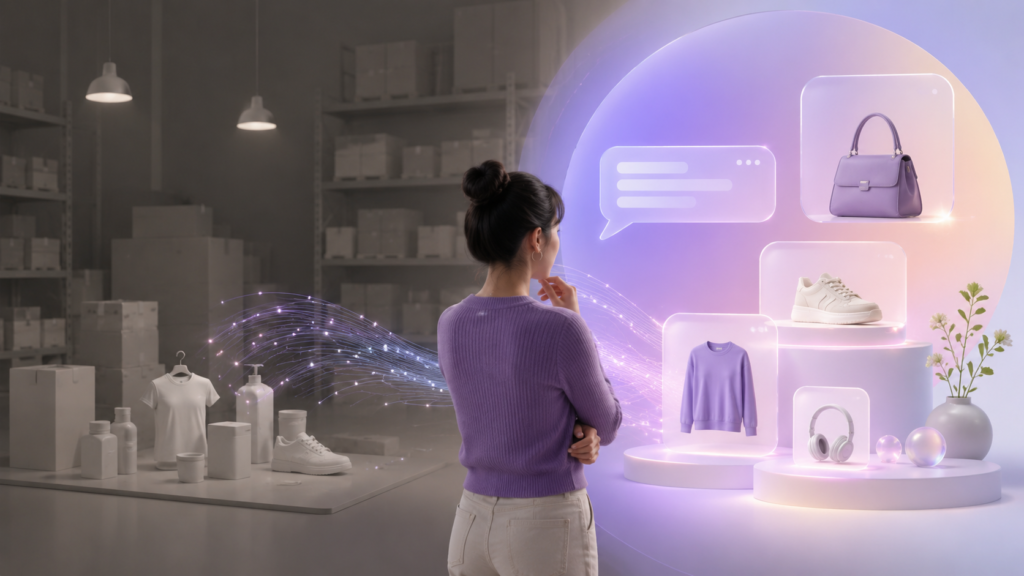
In a store, a strong salesperson would spot that moment and step in. Online, most e-commerce sites behave like silent warehouses: full of products, but short on proactive guidance. That is the conversion gap, the difference between passive digital browsing and guided in-store selling.
That gap matters in 2026. 7 in 10 shoppers globally want retailers to offer AI-powered shopping features, including AI shopping assistants, virtual try-ons, and voice-enabled product search.
Modern e-commerce CRO is no longer just about optimizing pages. It is about helping shoppers move from uncertainty to action before they bounce.
What is e-commerce conversion rate optimization?
E-commerce conversion rate optimization strategies mean improving your online store so that a higher percentage of visitors complete a valuable action, such as adding a product to cart, starting checkout, completing a purchase, requesting a demo, or engaging with a sales conversation.
Traditionally, e-commerce CRO has been treated as a UX and testing discipline. Teams test button copy, product page layouts, checkout forms, page speed, mobile design, and promotional messaging. Those tactics are still important, especially because cart and checkout friction remain persistent problems.
But in 2026, CRO needs to be treated as a commercial discipline. For enterprise e-commerce teams, conversion rate is shaped by the full buying journey: product discovery, catalogue complexity, comparison friction, shopper confidence, support availability, merchandising relevance, and whether your brand can intervene before a high-intent shopper leaves.
| Traditional CRO | Modern e-commerce CRO |
| Improves individual pages | Improves the buying journey |
| Reacts to drop-off after it happens | Engages shoppers before they bounce |
| Focuses on clicks, forms, and checkout | Focuses on confidence, guidance, and purchase intent |
| Tests static experiences | Creates live guided buying conversations |
| Optimizes for fewer obstacles | Optimizes for better decisions |
Why E-commerce CRO Needs to Move Beyond Passive Optimization
Most e-commerce CRO is reactive: teams review analytics after visitors leave, identify drop-off points, build hypotheses, run tests, and wait for results. That model is useful, but incomplete.
In high-consideration e-commerce, the critical conversion moment often happens before the cart. A shopper may be comparing similar products, decoding technical specs, checking fit for their use case, or seeking reassurance around delivery, returns, compatibility, sizing, or installation.
These are hesitation signals. Most e-commerce sites do not respond to them in real time. They wait for the shopper to search, click, ask, abandon cart, or leave. By then, the buying moment may be gone. You could call this the Conversion Gap: the difference between passive digital browsing and guided in-store selling.
The numbers make the gap hard to ignore. Physical retail stores often convert roughly 20% to 40% of visitors, while e-commerce sites typically convert closer to 2% to 3%. That creates a 10x to 15x gap between guided in-store selling and passive online browsing. The issue becomes clear: many shoppers are not leaving because they are uninterested. They are leaving because they are uncertain.
A proactive Digital Sales Workforce helps close that gap by identifying doubt and starting guided buying conversations. Agentic e-commerce infrastructure becomes a practical CRO layer. It gives brands a system that can observe hesitation, understand intent, and guide shoppers while they are still deciding.
AI sales agents can ask clarifying questions, recommend relevant products, compare options, surface upsells or cross-sells, answer buying questions, and help shoppers move toward the cart or checkout.
10 E-commerce Conversion Rate Optimization Strategies for 2026
1. Optimize for Buying Confidence, Not Just Clicks
A click is not the same as confidence.
A shopper can visit five product pages and still leave because they do not know which option is right. This is common in categories like furniture, electronics, appliances, automotive, luxury, and technical equipment, where decisions depend on fit, use case, specifications, compatibility, delivery, or long-term value.
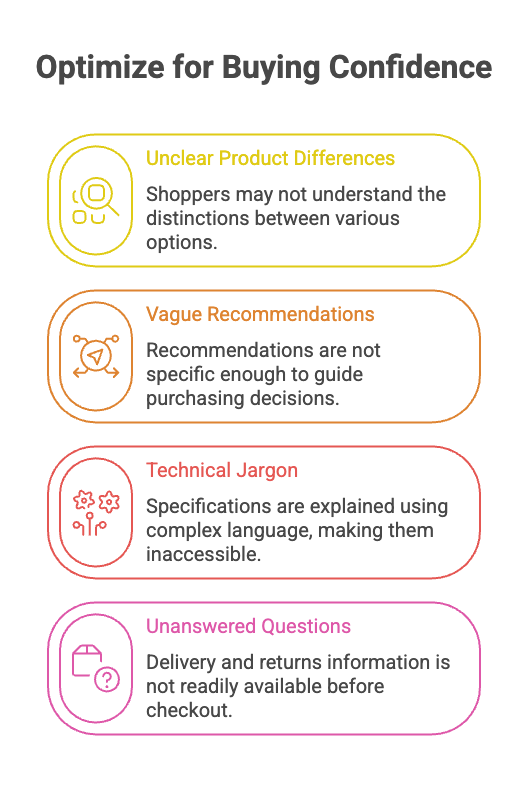
To improve conversion, audit the confidence gaps that appear before purchase: unclear product differences, vague recommendations, unexplained specifications, missing delivery information, weak compatibility guidance, or returns questions that only appear at checkout.
For example, a shopper comparing two premium coffee machines may not need another discount. They may need to know which model suits a small office, which is easier to maintain, and whether the higher-priced option is worth it.
2. Use Hesitation Signals to Engage Shoppers Before They Bounce
A shopper has three product tabs open, keeps returning to the same specification table, and has not added anything to the cart. That is not low intent. It is hesitation.
Hesitation signals can include toggling between similar products, lingering on specifications, repeatedly opening size guides, scrolling through reviews, returning to the same product page, or showing exit intent.
Traditional CRO identifies these patterns later. Proactive CRO responds while the shopper is still active.
A furniture shopper comparing sofas may need help with fabric durability, room size, seat depth, delivery constraints, or whether a modular configuration will fit through the door. A generic pop-up may interrupt them. A guided buying conversation can move them forward.
In this example, AI sales agents can identify hesitation signals and start guided buying conversations before shoppers abandon the journey, acting more like a digital salesperson watching the floor than reactive e-commerce chatbots waiting for a prompt.
3. Improve Product Discovery for Complex Catalogues
The larger the catalogue, the easier it is for qualified shoppers to get lost.
Filters help, but they assume shoppers already know what they need. Search helps only when shoppers use the right language. Product grids rarely explain trade-offs.
For enterprise brands, product discovery should feel more like a consultation. Shoppers should be able to explain what they want to achieve, what constraints they have, and what matters most. The experience should then guide them toward the right products, bundles, or categories.
Instead of forcing a customer to browse 150 laptop models, an AI sales agent can ask about budget, usage, portability, battery life, gaming needs, software requirements, and screen size. Then it can recommend a shortlist grounded in live catalogue data.
That is CRO because it reduces catalogue friction before it becomes abandonment.
4. Make Product Comparison Easier and More Commercially Useful
Comparison is one of the most important moments in e-commerce conversion, and one of the easiest to under-serve.
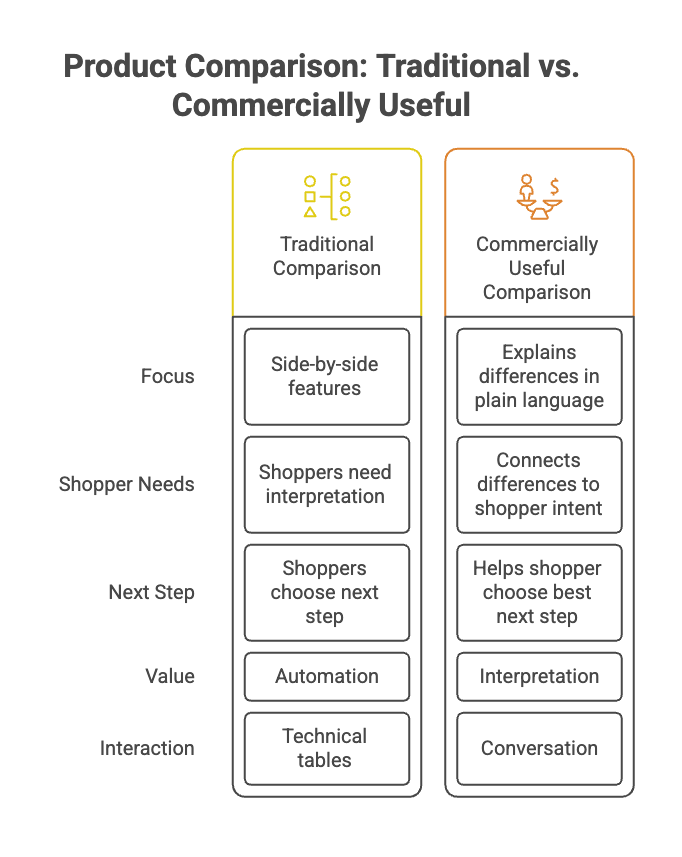
Most comparison tables show features side by side, but shoppers often need interpretation. They want to know what differences mean, which trade-offs matter, and which option fits their situation.
A commercially useful comparison should do three things: explain differences in plain language, connect them to shopper intent, and help the shopper choose the best next step.
For example, if two mattresses have similar pricing but different firmness levels, materials, warranties, and cooling properties, the opportunity is not just showing specs. It explains which mattress is better for side sleepers, hot sleepers, guest rooms, or long-term support.
The value is not just automation. It is an interpretation. AI sales agents can turn comparison into conversation, rather than leaving shoppers to decode technical tables on their own.
5. Personalize Recommendations Using Live Catalogue and Intent Data
Recommendation quality depends on two things: what the shopper wants and what the catalogue can actually support.
Basic AI personalization in e-commerce often means “people also viewed” or “recommended for you.” That is not enough for high-consideration e-commerce.
In 2026, effective recommendations need to combine shopper intent with live catalogue data. The goal is not to show more products. It is to recommend the right products at the right moment, with a clear reason.
Live catalogue awareness matters because recommendations depend on current product data that AI systems can retrieve and use during real-time buying journeys.
6. Turn Upsells and Cross-Sells into Helpful Guidance
The mistake is treating every upsell like a promotion. In high-consideration e-commerce, the better upsell often feels like advice.
A shopper buying a camera may genuinely need a compatible lens, memory card, tripod, case, or warranty. A shopper buying a sofa may need fabric protection, matching ottomans, delivery upgrades, or care products. The conversion and AOV opportunity comes from explaining why the add-on matters, not simply placing it in a carousel.
Helpful upselling is contextual. It should be based on the product, shopper intent, use case, and journey stage.
Guided selling can outperform static recommendations here. An AI sales agent can explain which add-ons are essential, which are optional, and which bundle provides better value. That turns cross-selling from a merchandising tactic into buying advice.
7. Reduce Checkout Uncertainty Before Checkout Starts
Checkout optimization still matters: faster forms, transparent costs, guest checkout, trusted payment options, and clear delivery information can all improve conversion.
But many checkout problems begin before checkout.
If a shopper is unsure about sizing, compatibility, delivery timing, warranty terms, returns, installation, or whether they chose the right product, they may never reach the checkout page.
CRO teams should identify the questions that repeatedly appear late in the journey and answer them earlier through product pages, comparison flows, guided selling experiences, and AI sales conversations.
If delivery and return concerns drive abandonment, those answers should not be buried in a policy page. They should appear in context during the buying decision.
8. Align Merchandising Priorities With Live Shopping Conversations
Most e-commerce merchandising happens through collection pages, banners, search rules, promotions, and product placement.
But shoppers increasingly make decisions through conversational journeys. If your team wants to prioritize high-margin products, clear overstock, promote seasonal bundles, or guide shoppers toward specific product lines, those rules need to inform the buying conversation too.
The key is control. Enterprise teams should not rely on black-box AI recommendations that ignore commercial priorities. They need a clear Commercial Playbook that lets merchants guide AI sales agents in recommending products, positioning bundles, handling objections, and staying aligned with brand strategy.
That turns AI-led CRO into a controlled revenue lever rather than random automation. It also ensures guided selling is connected to the broader commercial workflows that move shoppers from intent to conversion.
9. Test AI-Led Buying Journeys Before They Go Live
If an AI sales agent is recommending products, comparing specifications, answering policy questions, or guiding shoppers toward checkout, AI governance, brand safety, testing, and security controls matter.
Teams should be able to test how AI agents answer product questions, handle edge cases, follow policies, recommend alternatives, and respond when they lack enough information. They should also review whether the experience reflects the brand’s tone, merchandising priorities, and customer promises.
Melingo’s Simulator supports this trust layer by letting teams test AI sales agents before deployment. It helps teams review accuracy, policy fidelity, brand safety, and hallucination risk before the experience goes live.
10. Connect Sales, Service, and Product Expertise in One Journey
Shoppers do not experience your site in departments. They experience one buying journey.
A pre-purchase delivery question can become the deciding factor. A compatibility question can become an upsell opportunity. A return policy question can determine whether the shopper feels confident enough to purchase.
Modern e-commerce CRO needs sales, service, and product expertise to work together in the same journey.
For example, a shopper may ask whether a product ships to their area. Once that concern is resolved, the next best step may be a product comparison, a bundle recommendation, or a move to the cart.
This is where a unified sales-to-service bridge becomes valuable. Support is still important, but the mission is sales. The best AI sales agents not only deflect repetitive questions. They resolve the concern, then keep the buying journey moving.
What Enterprise Brands Should Look For in E-commerce CRO Technology
Enterprise e-commerce teams should evaluate AI tools for e-commerce based on whether they improve the buying journey, not only whether they add another widget to the site.
The right platform should support:
| Buying criterion | Why it matters |
| Proactive engagement | Helps shoppers before they abandon the journey |
| Complex catalogue understanding | Supports large, technical, or high-consideration product ranges |
| Guided product discovery | Moves shoppers from broad intent to relevant options |
| Live catalogue awareness | Grounds recommendations in real product data |
| Product comparison support | Helps shoppers understand trade-offs and choose confidently |
| Merchant control | Aligns AI guidance with commercial priorities |
| Testing and governance | Supports accuracy, policy fidelity, and brand safety |
| Support-to-sales capability | Turns service questions into continued buying momentum |
| Commercial alignment | Connects AI engagement to conversion, AOV, and paid traffic efficiency |
Turn More Browsers Into Confident Buyers
E-commerce CRO in 2026 is about more than removing friction from pages.
Faster sites, stronger product pages, better checkout flows, and clearer messaging still matter. But they do not solve the full problem. If shoppers cannot find the right product, understand the difference between options, get answers in the moment, or feel confident enough to buy, they will still leave.
The next layer of e-commerce CRO is a proactive revenue layer designed to help enterprise brands convert more of their existing traffic into confident buyers.
Melingo represents the next layer of agentic e-commerce infrastructure: a Digital Sales Workforce built to help close the Conversion Gap between passive browsing and guided in-store selling.
Melingo’s AI sales agents identify hesitation signals, start guided buying conversations, recommend relevant products from live catalogue data, support comparisons, surface helpful upsells and cross-sells, answer buying questions, and help shoppers move toward cart or checkout before they bounce.
Ready to turn more passive traffic into guided buying conversations? Book a Melingo demo.