Abstract
AI personalization in ecommerce is the use of artificial intelligence to adapt the shopping journey in real time based on each shopper’s intent, behavior, context, and product needs. Instead of showing every visitor the same product grids, AI personalization helps ecommerce brands guide shoppers toward the right products, answers, comparisons, and next steps before they leave.
Examples of AI personalization in ecommerce
- Conversational product discovery
- Proactive engagement based on hesitation signals
- Personalized product comparisons
- AI-powered product recommendations
- Personalized upsells and cross-sells
- Personalized search results
- Dynamic merchandising and collection pages
- Tailored support that connects service questions to buying guidance
Most ecommerce sites are still silent warehouses.
A shopper lands on the site, browses a large catalogue, compares products, checks specifications, hesitates, and leaves. In a physical store, a strong salesperson would notice that moment. They would ask what the shopper is trying to solve, explain the difference between the two options, and help them buy with confidence.
This matters because AI personalization in ecommerce is no longer a nice-to-have. McKinsey reports that 71% of consumers expect personalized interactions, while 76% get frustrated when they do not receive them. For enterprise ecommerce teams spending heavily on paid acquisition, every generic journey creates risk: wasted traffic, confused shoppers, missed upsell opportunities, and preventable abandonment.
What is AI personalization in ecommerce, and why is it moving beyond recommendations?
AI personalization in ecommerce uses artificial intelligence to tailor the customer journey based on live shopper signals and product data.
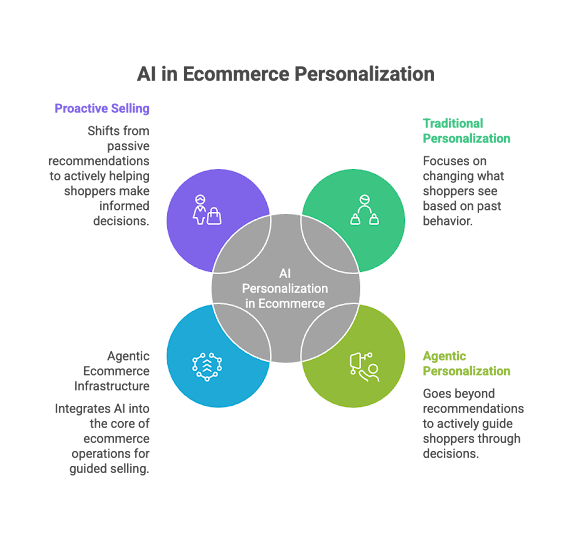
Traditional personalization changes what shoppers see: recently viewed products, recommendations, or email offers based on past behavior. Agentic personalization goes further. It changes how shoppers are guided. It can infer intent and likely hesitation, ask clarifying questions, compare products, explain trade-offs, recommend add-ons, and move the shopper toward a more confident purchase.
As ecommerce moves from passive personalization to proactive selling, the brands that win will be the ones that treat AI as part of their sales infrastructure, not just another onsite widget.
This is where the AI sales revolution becomes practical for ecommerce. AI sales agents move personalization beyond recommendations and turn it into guided buying conversations before shoppers bounce.
A shopper comparing two sofas may need help with room size, fabric durability, seat depth, delivery constraints, or doorway fit. A shopper comparing laptops needs a plain-language explanation of performance, battery life, graphics, and which model fits their use case.
Why AI Personalization Matters Now
Standard personalization waits for the shopper to act. This is where onsite personalization and marketing attribution recommendations should be viewed together: attribution helps ecommerce teams understand which channels bring valuable visitors, while AI personalization helps convert more of those visitors once they arrive.
It waits for them to search, click, filter, compare, abandon cart, or return later through retargeting. By then, the most valuable moment has passed. Proactive AI personalization responds while the shopper is still deciding.
That gap is measurable. Melingo frames the Conversion Gap around a simple reality: physical stores can convert 20–40% of visitors through human guidance, while many ecommerce sites convert only a small fraction of traffic.
As an agentic ecommerce infrastructure platform, Melingo gives enterprise brands a proactive Digital Sales Workforce designed to close that gap by identifying hesitation signals, starting guided buying conversations, and helping shoppers move toward cart or checkout with more confidence.
7 Examples of AI Personalization in Ecommerce
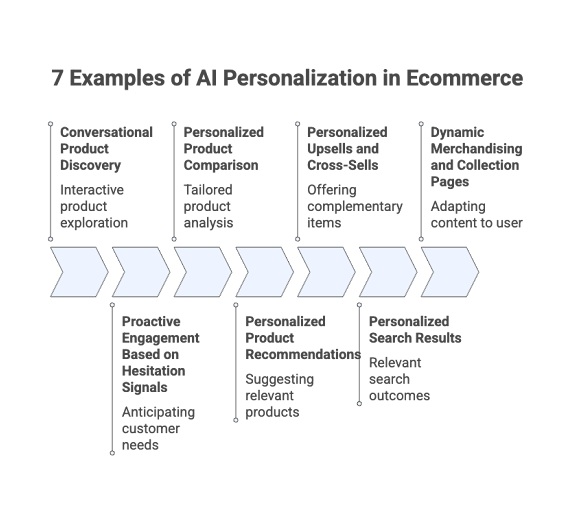
For enterprise brands, the right AI personalization platform should support ecommerce growth without sacrificing accuracy, control, or customer trust.
1. Conversational Product Discovery
Conversational product discovery lets shoppers describe what they need in natural language instead of forcing them to navigate rigid filters, product categories, or search terms.
The shopper starts with a broad need rather than a specific product name. They ask, “I need a compact sofa for a small apartment,” “What laptop should I buy for travel and video calls?” or “Which skincare products work for sensitive skin?”
What the AI detects:
The AI infers the shopper’s use case from queries, clicks, filters, and conversation inputs. It detects that the shopper needs help with size, compatibility, budget, material, performance, sensitivity, or routine fit.
The AI asks clarifying questions and narrows the catalogue into a relevant shortlist. It might ask whether the sofa will be used daily, whether the laptop should prioritize battery life, or whether the shopper has ingredients they avoid.
With Melingo, conversational product discovery becomes part of the Digital Sales Workforce: AI sales agents ask clarifying questions, interpret intent, and recommend products using live catalogue data.
2. Proactive Engagement Based on Hesitation Signals
Many shoppers do not ask for help. They show uncertainty through behavior, then leave.
Proactive engagement uses behavioral intelligence to identify hesitation signals and start a relevant conversation before the shopper bounces. Instead of waiting for the shopper to open a chat window, an AI agent can step in when behavior shows signs of uncertainty.
The shopper views the same product multiple times, toggles between similar models, dwells on a specification table, returns to delivery or sizing information, applies and removes filters, or moves toward exit after viewing a high-intent product page.
What the AI detects:
These patterns suggest the shopper is not browsing casually. They are interested enough to keep engaging, but something is stopping them from moving forward. That blocker is sizing, compatibility, delivery, price, or simply not knowing which option is the safer choice.
The AI sales agent offers context-aware help instead of a generic discount pop-up. For example: “Are you choosing between these two models? I can explain the main differences,” or “Would you like help checking the right size before you leave?”
For ecommerce teams, hesitation often happens close to purchase. The solution would be to choose an AI sales agent that employs Hesitation Signals to identify when a shopper needs guidance and starts a relevant buying conversation before they bounce.
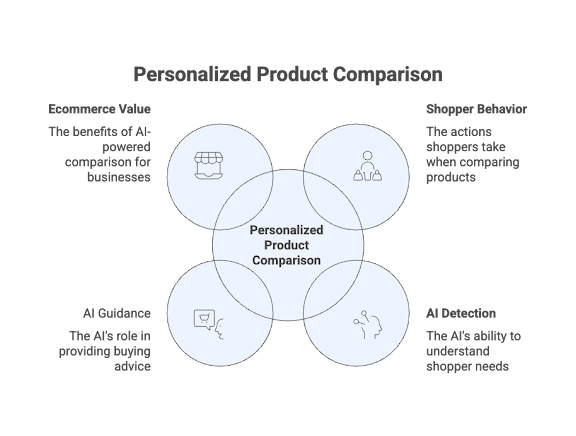
3. Personalized Product Comparison
Comparison is one of the clearest signs of buying intent. It is also where complexity can kill conversion.
Personalized product comparison uses AI to explain the difference between products based on what the shopper cares about, not just what is listed in the product table.
The shopper compares two or more products with similar features, prices, or specifications. They move back and forth between product pages, open comparison tools, revisit reviews, or spend time on technical details.
What the AI detects:
The AI recognizes that the shopper needs help interpreting trade-offs. They may not understand which difference actually matters for their use case, or they could be unsure whether the more expensive option is worth it.
The AI turns product data into buying guidance. For example, one laptop is better for travel because it is lighter and has longer battery life, while another is better for editing or gaming because it has stronger graphics performance.
For ecommerce teams, the value is relevance. Melingo’s AI sales agents turn catalogue data into use-case-specific buying guidance, helping shoppers understand which product is the better fit rather than simply showing them another comparison table.
4. Personalized Product Recommendations
Traditional recommendation engines usually answer a narrow question: “What products are similar to this one?” or “What did other customers also buy?”
AI-powered personalization should answer a better question: “What is the right product for this shopper’s goal?”
The shopper browses products, searches by need, engages with categories, answers questions, views related items, or adds products to cart.
What the AI detects:
The AI infers budget sensitivity from filters, sorting behavior, and product comparisons.
The AI recommends products based on use case, product attributes, availability, compatibility, and merchant rules. If a shopper is viewing an outdoor dining table, it might recommend a weather-resistant set, matching chairs, a cover, or a smaller balcony option.
This only works when the AI is connected to accurate, structured product and commerce data. Otherwise, the AI is left guessing, which leads to vague recommendations and weaker trust. For ecommerce teams, explainable recommendations matter. Shoppers are more likely to trust a recommendation when they understand why it fits their need.
5. Personalized Upsells and Cross-Sells
Upsells and cross-sells work when they feel useful. They fail when they feel random or pressured. AI personalization can recommend add-ons, bundles, or premium alternatives based on the shopper’s intent and the product they are considering.
The shopper views a product, compares options, adds an item to cart, asks about compatibility, or reaches a buying decision but has not yet completed the purchase.
What the AI detects:
The AI identifies whether there is a relevant opportunity to improve, complete, or protect the purchase. That could mean a required accessory, a compatible add-on, a better-fit premium version, or a bundle that matches the shopper’s use case.
The AI recommends the upsell or cross-sell with a clear reason. For example: “This mount is compatible with the TV size you selected,” or “The upgraded version is better for outdoor use because it has a more durable finish.”
For ecommerce teams, this supports AOV without weakening trust. Map high-volume products to required, recommended, and premium add-ons, then define when each should appear.
Melingo’s Commercial Playbook supports this control by allowing merchants to brief agents on priorities, such as seasonal bundles, overstock, or high-margin products, as appropriate.
6. Personalized Search Results
Search is where shopper intent becomes explicit. But many ecommerce search experiences still depend too heavily on exact keywords. For brands with large or technical catalogues, this is where ecommerce personalization starts to overlap with enterprise search solutions: shoppers need search that understands intent, product attributes, compatibility, and context, not just exact-match keywords.
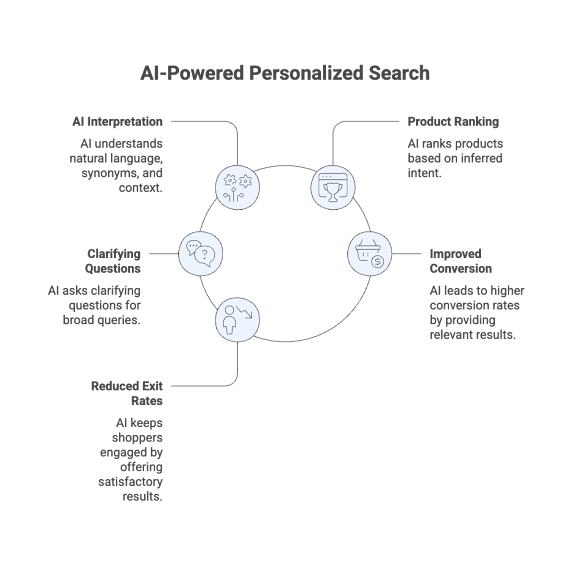
AI-powered personalized search can interpret natural language, synonyms, context, and behavior to return more useful results.
The shopper searches for a product, problem, use case, or vague need. They might search for “sofa for pets,” “laptop for travel,” “best mattress for back pain,” or “gift for new homeowner.”
What the AI detects:
The AI infers the underlying requirement behind the words. A search for “sofa for pets” may imply durable fabrics, darker colors, easy-clean materials, and scratch-resistant construction. A search for “laptop for travel” implies lightweight design, battery life, and portability.
AI can rank products based on inferred intent when search, behavior, and catalogue data are connected. It could also ask a clarifying question, such as: “Are you looking for a pet-friendly sofa mainly because of shedding, scratching, or easy cleaning?”
For ecommerce teams, poor search results are expensive. Review zero-result searches, low-conversion searches, and high-exit search terms to find where keyword-based discovery is failing.
7. Dynamic Merchandising and Collection Pages
Dynamic merchandising uses AI to adapt product ordering, featured items, and collection pages based on shopper intent, catalogue data, and merchant-defined commercial rules. These rules should be governed by merchandising controls, availability checks, margin logic, and brand restrictions so the AI does not prioritize commercial goals at the expense of relevance or trust.
What the shopper does:
The shopper browses a category, collection, campaign page, or product grid. They filter by price, click into premium products, return to a seasonal collection, or repeatedly view a specific product type.
What the AI detects:
The AI combines shopper context with catalogue and commercial priorities. It identifies that the shopper is price-sensitive, browsing premium products, looking for a seasonal category, or returning to a specific product type.
AI can adjust product prioritization within merchant-defined rules and availability constraints. For example, it may prioritize high-margin products when equally relevant, promote seasonal bundles, avoid out-of-stock products, or surface premium alternatives when the shopper shows strong intent.
For ecommerce teams, this connects merchandising strategy to live shopper behavior. Separate shopper-first rules from commercial-priority rules: one protects relevance, the other guides margin, inventory, and campaign goals.
While dynamic merchandising can adjust product ordering across collection pages, Melingo’s role is different. Melingo brings merchandising priorities into guided buying conversations through live catalogue data, merchant-defined rules, and the Commercial Playbook.
This stage is where agentic ecommerce infrastructure separates from a generic AI widget. Instead of simply changing what appears on a page, Melingo helps you guide shoppers through buying decisions with proactive, catalogue-aware sales conversations that remain under merchant control.
How AI Personalization Works in Ecommerce
AI personalization is only as useful as the signals it can work with. At a basic level, it needs behavioral signals: what the shopper is clicking, comparing, filtering, revisiting, or abandoning. It also needs intent signals, such as search terms, product questions, category visits, and conversation inputs.
For enterprise ecommerce, that is not enough. The AI also needs accurate catalogue data: product attributes, availability, compatibility, pricing, variants, bundles, delivery options, and approved content.
Finally, it needs commercial rules from the merchant, such as which products to prioritize, which bundles to promote, and which recommendations to avoid.
Integrating AI into ecommerce requires more than adding a chat interface. It requires live catalogue data, merchant control, and clear guardrails so personalization can support conversion without weakening trust.
Without those layers working together, personalization can look smart on the surface but fail at the moment that matters: helping the shopper choose.
What Enterprise Brands Should Look for in AI Personalization
Enterprise teams should not evaluate AI personalization by the demo alone. The system needs accurate product data, merchant controls, brand-safe responses, and clear governance.
Look for AI personalization capabilities that support:
- Live catalogue data, so recommendations reflect real product details
- Merchant controls, so commercial priorities can be guided intentionally
- Brand-safe responses, so the customer experience stays consistent
- Testing before deployment, so teams can validate accuracy and policy fidelity
- Grounded answers drawn from live catalogue data and approved content, so shoppers receive product guidance based on accurate and merchant-defined guardrails
- Support-to-sales capability, so service questions can become revenue opportunities when appropriate
- Commercial alignment, so personalization supports conversion, AOV, merchandising, and CX goals
Turn Personalization Into Guided Buying Conversations
AI personalization in ecommerce is no longer just about changing product grids or sending better emails. The strongest examples help shoppers choose faster, compare with confidence, resolve uncertainty, and move toward checkout.
Melingo gives ecommerce teams a proactive Digital Sales Workforce that personalizes the buying journey in real time. Its AI sales agents engage shoppers when they show signs of hesitation, ask useful questions, recommend products from live catalogue data, support comparison, surface relevant upsells and cross-sells, and help customers move from comparison to checkout.
If your site is still behaving like a silent warehouse, personalization should not stop at recommendations.
Book a demo to see how Melingo turns AI personalization into proactive guided selling.